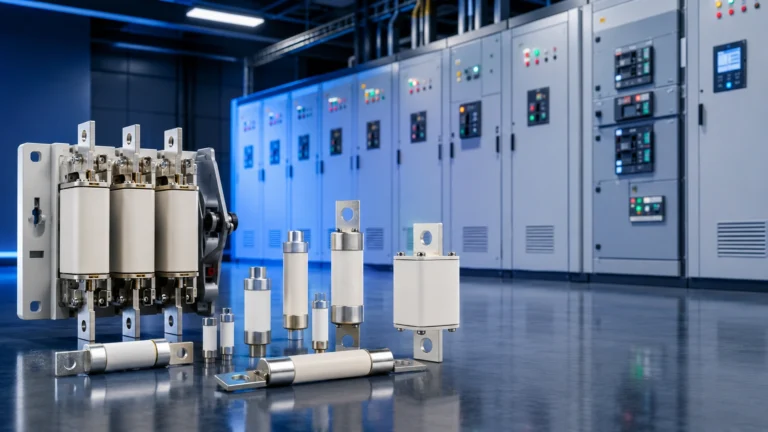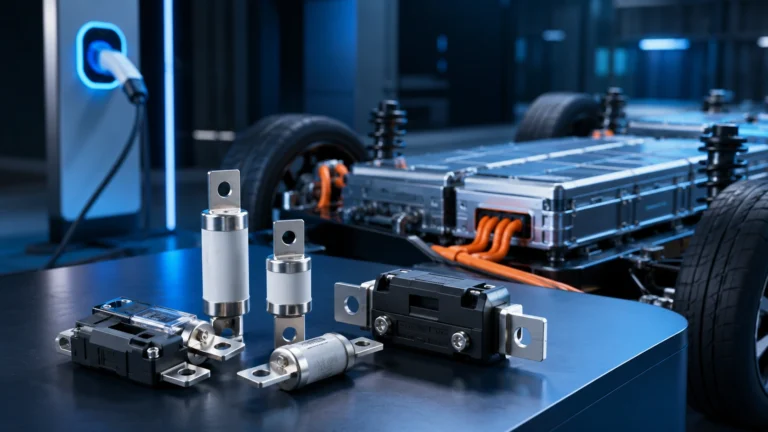
As photovoltaic systems increase in voltage and capacity, overcurrent protection becomes an important part of system safety.
A solar installation may contain hundreds or thousands of PV modules connected through strings, combiner boxes, DC distribution cabinets and inverters. A fault in one part of the system may allow current from other parallel strings or connected energy sources to flow toward the affected circuit.
Photovoltaic fuses are designed to interrupt these abnormal currents before they damage cables, modules or other DC equipment.
What Is a Photovoltaic Fuse?
A photovoltaic fuse is a DC fuse specifically designed for solar power systems.
Unlike a standard general-purpose fuse, a PV fuse must operate under conditions that may include:
- Continuous DC voltage
- Relatively low fault-current multiples
- Reverse current from parallel PV strings
- High outdoor temperatures
- Repeated daily loading
- Long operating periods
- High system voltages
Specialized PV fuse families are used to protect photovoltaic modules and conductors from reverse-overcurrent conditions. Industry product ranges commonly cover string circuits, combiner boxes, inverters and related solar-distribution equipment.
Where Are PV Fuses Installed?
PV String Protection
When multiple strings are connected in parallel, current from healthy strings may flow into a faulted string.
String fuses help isolate the affected branch and protect the module cables from reverse overcurrent. Compact cylindrical PV fuses are often used at this protection level.
Combiner Box Protection
A combiner box collects the outputs of multiple PV strings.
Fuses may be installed on individual inputs and at the combined output, depending on the system architecture. The selected fuse must be suitable for the maximum DC voltage and available fault current.
Inverter Input Protection
Larger fuse links may be used between the combiner output and the inverter.
These devices help protect DC cables and inverter input circuits from overload and short-circuit conditions.
Energy Storage and DC Distribution
Solar installations increasingly operate together with battery storage and other DC equipment. Each source and distribution branch should be evaluated separately because its voltage, current direction and fault-current behavior may differ.
WERON Photovoltaic Fuse Product Range
WERON’s photovoltaic product range includes:
- WRPV-30 Photovoltaic Fuse
- WRPV-32L Photovoltaic Fuse
- WRPV-63L Photovoltaic Fuse
- WRPV-80 Photovoltaic Fuse
The series covers compact cylindrical fuse links and higher-current PV protection configurations for different positions within a solar DC system. Compatible fuse holders and indicating devices are also available for selected models.
Rather than using one fuse throughout the entire installation, system designers can select an appropriate WRPV model according to the string current, system voltage, installation position and required breaking performance.
Six Factors for Selecting a Photovoltaic Fuse
1. Maximum DC System Voltage
The rated DC voltage of the fuse must be equal to or higher than the highest voltage that may appear across the fuse.
The maximum open-circuit voltage of the PV array should be calculated under the lowest expected ambient temperature, because module voltage can increase as temperature decreases.
2. Maximum Continuous Current
The fuse must carry normal operating current without unnecessary operation.
The engineer should consider module short-circuit current, design safety factors, ambient temperature, enclosure temperature and the thermal influence of adjacent fuse holders.
3. Reverse-Current Protection
The fuse rating should be low enough to protect the module and string cable from reverse current, while remaining high enough to carry normal operating current.
The module manufacturer’s maximum series fuse rating should also be considered.
4. Breaking Capacity
The fuse must safely interrupt the maximum available fault current from all connected sources.
This may include current from parallel PV strings, inverters, batteries or other DC-connected equipment.
5. Fuse Category and Time-Current Performance
PV applications should use fuse links specifically intended for photovoltaic protection.
A standard AC fuse or a fuse with an unsuitable operating curve may not safely interrupt the expected DC fault conditions.
6. Fuse Holder and Disconnecting Device
The fuse link and holder should be evaluated as a complete assembly.
Contact resistance, ventilation, conductor size and terminal tightness can affect operating temperature. Where isolation is required, a suitable fuse disconnect switch should be considered.
Common PV Fuse Selection Mistakes
Common mistakes include:
- Selecting the fuse only by rated current
- Ignoring the maximum cold-weather system voltage
- Using an AC fuse in a DC application
- Failing to account for parallel-string reverse current
- Installing a fuse with insufficient breaking capacity
- Mixing incompatible fuse links and holders
- Ignoring cabinet temperature and ventilation
- Using the same fuse rating at every system level
Avoiding these mistakes helps improve system protection and reduce unnecessary maintenance.
Protect Every Level of the Solar DC System
An effective solar protection design may include different fuse sizes at the string, combiner, inverter and distribution levels.
WERON photovoltaic fuses provide product options for a range of solar DC protection requirements. WERON also supplies fuse disconnect switches that can support switching, isolation and overcurrent protection in PV distribution systems.
| Send WERON your PV system voltage, string current, number of parallel strings and installation position for product-selection support. |
Technical Reference Notes
- Shanghai WERON Technology Co., Ltd. Product Selection Guide: Photovoltaic Fuses Series, WRPV-30, WRPV-32L, WRPV-63L and WRPV-80.
- Littelfuse: Solar fuse applications for photovoltaic strings, combiner boxes and inverters.
- Industry practice for gPV fuse coordination in high-voltage DC solar systems.