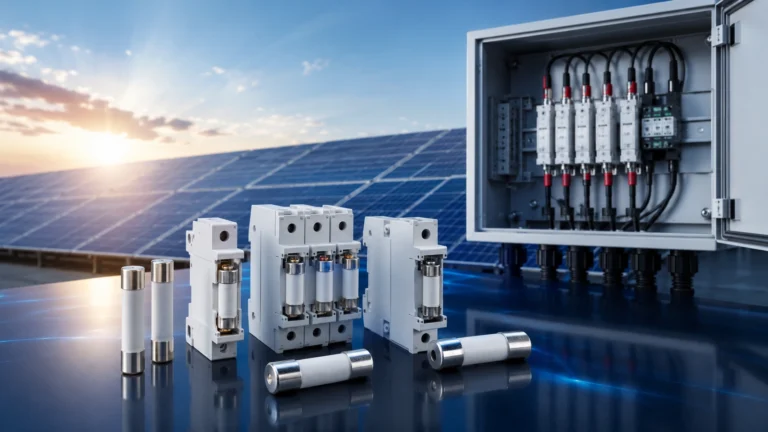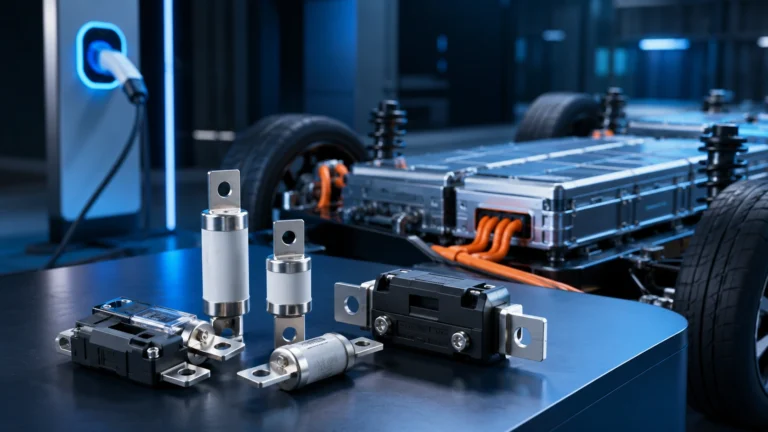
| Industrial fuse solutions for power distribution, control panels and electrical equipment protection.· |
Industrial power systems contain cables, motors, control components, distribution boards and production equipment that may be exposed to overloads or short-circuit faults. Selecting the right industrial fuse helps isolate these faults before they cause extensive damage to electrical equipment or interrupt the entire production process.
However, there is no single fuse suitable for every application. Knife type fuses, cylindrical fuses, wedge type contact fuses and fuse disconnect switches are designed for different circuit conditions, installation methods and protection requirements.
This guide explains how to choose the most appropriate fuse solution for an industrial power distribution system.
Why Industrial Fuse Selection Matters
A fuse must interrupt a fault safely while allowing the protected circuit to operate normally under expected load conditions.
An underrated fuse may operate during normal current peaks, while an oversized fuse may not provide sufficient protection for cables or equipment. The selection process therefore needs to consider more than rated current alone.
- System voltage
- Normal operating current
- Prospective short-circuit current
- Fuse utilization category
- Load characteristics
- Installation method
- Ambient temperature
- Coordination with upstream and downstream devices
Industrial NH gG fuse links, for example, are commonly used as full-range protection devices for cables and electrical equipment. Their current-limiting performance also helps reduce the mechanical and thermal effects produced by high short-circuit currents.
Knife Type Fuses for Industrial Power Distribution
Knife type fuses, also known as NH fuse links, are widely used in industrial distribution boards, switchgear, motor circuits and feeder protection.
Their blade-style contacts provide a secure connection suitable for higher-current circuits. Depending on the fuse category and system design, they can protect:
- Industrial cables and feeders
- Distribution transformers
- Motors and production equipment
- Low-voltage switchboards
- Main and sub-distribution circuits
WERON’s NT/NH Series Knife Type Fuses are designed for industrial power protection applications. The series includes multiple fuse sizes and current ratings, allowing engineers to select a fuse link according to the capacity of the protected circuit.
Knife type fuses are generally a suitable choice when the application requires high breaking capacity, reliable current limitation and a robust installation structure.
Cylindrical Fuses for Control and Distribution Circuits
Cylindrical fuses are compact and easy to integrate into control panels and modular distribution systems. They are commonly installed in DIN-rail fuse holders, making inspection and replacement more convenient.
Typical applications include:
- Control circuits
- Distribution panels
- Industrial machinery
- Auxiliary power circuits
- Measurement and monitoring equipment
- Cable and branch-circuit protection
Depending on their operating class, cylindrical fuses may be used for general cable protection, motor circuits or fast protection of sensitive electrical components. Official industry product ranges also pair cylindrical fuse links with modular holders, optional indicators and remote fuse-status monitoring functions.
WERON’s RT18 Series Cylindrical Fuses and Fuse Holders provide a compact solution for control and low-voltage distribution applications. Different holder configurations allow the products to be integrated into a wide range of electrical panels.
| Cylindrical fuse links and fuse holders integrated into a modern industrial control panel. |
Wedge Type Contact Fuses for Demanding Power Circuits
Wedge type contact fuses use a robust contact structure that supports stable electrical connection in high-current AC circuits.
They are particularly suitable for applications where the fuse may experience demanding electrical or mechanical conditions, such as:
- Industrial power equipment
- Heavy-duty distribution circuits
- Electrical cabinets
- High-current protection systems
- Equipment requiring firm contact pressure
WERON wedge type contact fuses are available in several configurations and current ratings, providing overload and short-circuit protection for industrial power circuits.
When selecting this type of fuse, engineers should confirm the mounting dimensions, terminal structure, rated current and compatibility with the corresponding fuse base.
Fuse Disconnect Switches for Protection and Isolation
A fuse disconnect switch combines fuse protection with a visible or mechanically controlled isolation function.
This makes it suitable for systems where maintenance personnel need to disconnect the circuit before inspection or replacement. Typical applications include industrial feeders, distribution cabinets and renewable-energy distribution systems.
WERON offers HR17 Series Fuse Disconnect Switches together with CTR Series fuse rails and disconnecting components. These products provide different mounting arrangements for distribution and industrial control systems.
A properly selected fuse disconnect switch can help:
- Simplify circuit isolation
- Improve maintenance accessibility
- Integrate switching and fuse protection
- Reduce the number of separate panel components
- Support safer fuse replacement procedures
Key Factors When Selecting an Industrial Fuse
1. Rated Voltage
The fuse voltage rating must be equal to or higher than the maximum system voltage. AC and DC ratings should not be treated as interchangeable.
2. Continuous Operating Current
The selected fuse must carry the normal current without nuisance operation. Ambient temperature, cabinet ventilation and current cycling may require additional derating.
3. Breaking Capacity
The fuse must be capable of safely interrupting the maximum prospective fault current at its installation point.
4. Utilization Category
Different fuse categories are intended for general cable protection, motor circuits, semiconductor protection, transformer protection or other specialized loads.
5. Physical Size and Mounting
The fuse must match the dimensions and contact structure of the fuse holder, base or disconnect switch.
6. Selective Coordination
The fuse should coordinate with upstream and downstream protective devices so that the device closest to the fault operates first whenever possible.
Build a More Reliable Industrial Protection System
Selecting an industrial fuse is not simply a matter of matching the rated current. The engineer must evaluate the circuit voltage, load profile, fault level, protection target and installation environment together.
WERON provides knife type fuses, cylindrical fuses, wedge type contact fuses and fuse disconnect switches for industrial power distribution and control applications.
| Contact WERON with your voltage, current, fuse size and application requirements to receive a suitable product recommendation. |
Technical Reference Notes
- Shanghai WERON Technology Co., Ltd. Product Selection Guide: NT/NH Series, RT18 Series, Wedge Type Contact Fuse and Fuse Disconnect Switch product sections.
- Mersen: NH fuse links for industrial cable and equipment protection.
- Eaton Bussmann Series: Low-voltage IEC cylindrical fuses and fuse holders.